Key Takeaways
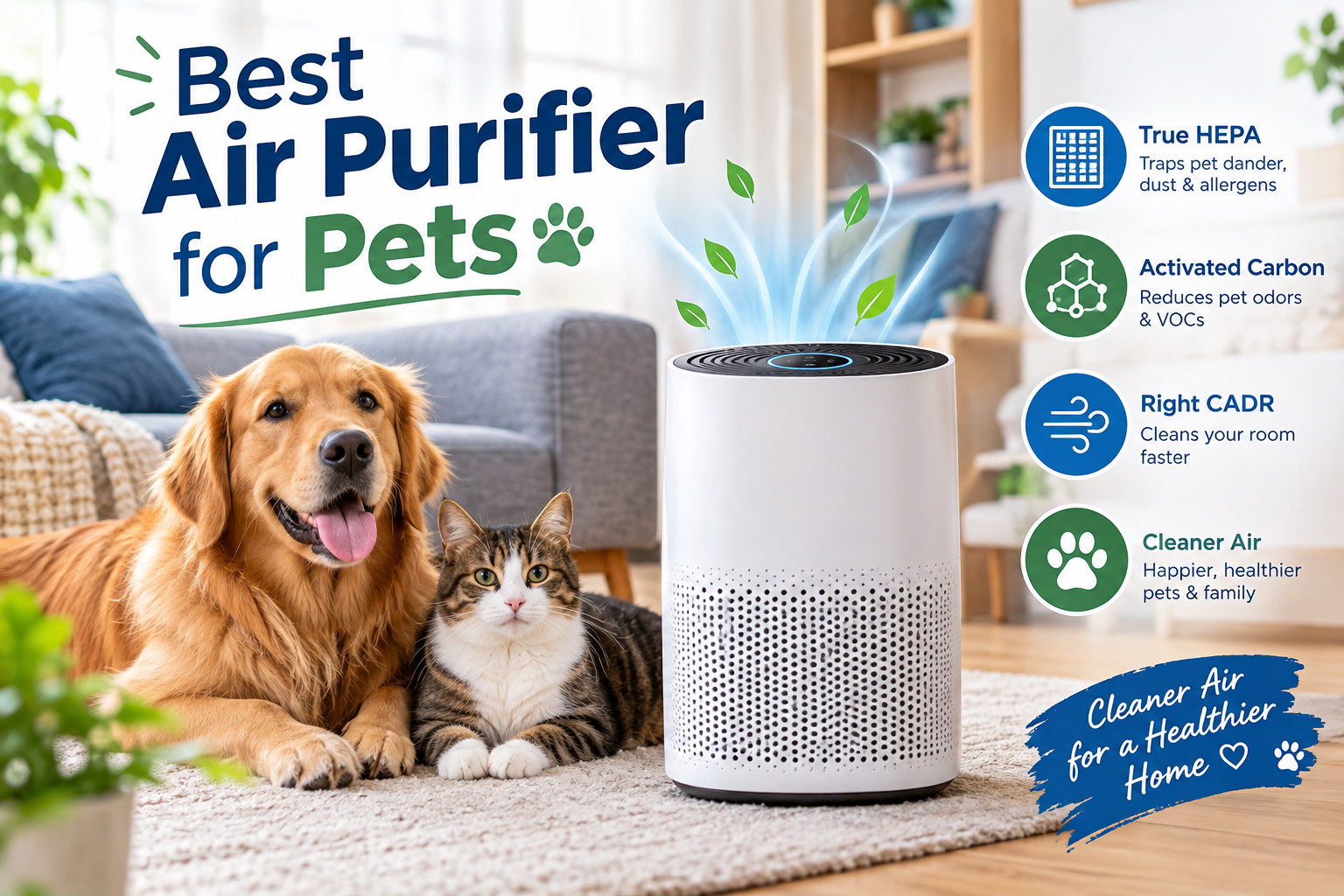
- The best air purifier pets benefit from combines true HEPA filtration with an activated carbon layer for odor control.
- Room size matters more than brand name — check the CADR (Clean Air Delivery Rate) rating and match it to your actual square footage using the formula below.
- Washable pre-filters save money over time but still need a HEPA filter replacement every 6–12 months.
- Ionizers can produce ozone, a lung irritant — check for CARB (California Air Resources Board) certification if you’re considering one.
- Air purifiers help reduce airborne dander and odor, but they don’t replace regular grooming, vacuuming, or vet care for allergies.
- Placement matters. A purifier works best near where your pet sleeps or spends most of its time.
- If your pet has ongoing allergy symptoms, talk to your vet — an air purifier is one part of a bigger plan, not a fix on its own.
Introduction
Pet parents search for the best air purifier pets can live with because fur, dander, and odor build up fast in a home with animals. In fact, even a well-groomed dog or cat sheds tiny particles every day, and those particles float in the air long after you’ve vacuumed.
That said, an air purifier tackles the part of pet ownership that grooming and cleaning can’t fully solve: what’s floating in the air itself. However, it won’t replace a good brush or a clean litter box — instead, it works alongside your normal pet care routine.
With that in mind, this guide breaks down what to look for, which features actually matter, how to size a unit correctly, what it costs to run one, and honest answers to the questions pet owners ask most before buying.
What Is a Pet Air Purifier?
A pet air purifier is an appliance that pulls air through a series of filters to remove hair, dander, dust, and odor particles. Most models made for pet owners use a true HEPA filter as the main filtration layer.
HEPA filters trap particles as small as 0.3 microns, which covers most pet dander and dust. Many pet-specific units add a second layer: activated carbon. This layer absorbs odor molecules that HEPA filters can’t catch on their own.
Why Pet Owners Need a Different Setup Than Standard Purifiers
Standard air purifiers focus on dust and smoke. Pet owners deal with a heavier, steadier particle load: fur, dander, and litter box or urine odor. A pet-focused purifier usually has a larger pre-filter to catch bigger hair clumps before they clog the HEPA layer underneath.
Quick Facts Box
| Fact | Details |
|---|---|
| Main filter type | True HEPA (captures particles down to 0.3 microns) |
| Odor control layer | Activated carbon |
| Filter lifespan | 6–12 months for HEPA, 3–6 months for carbon (varies by use) |
| Room coverage | Match CADR to your actual room square footage (see formula below) |
| Washable filters | Common on pre-filters; HEPA filters are rarely washable |
| Noise level | Under 50 decibels on low/medium; check high-speed rating separately |
| Running cost | Roughly 5–50 watts depending on fan speed and unit size |
How to Match CADR to Your Room Size
CADR measures cubic feet of clean air delivered per minute. As a simple rule of thumb, divide your room’s square footage by 1.55 — that gives you the minimum smoke or dust CADR you want, assuming you want the air fully cleaned about 4–5 times per hour, which is the standard recommendation for pet owners.
| Room Size | Minimum Recommended CADR |
|---|---|
| 150 sq ft (small bedroom) | ~100 |
| 300 sq ft (living room) | ~200 |
| 450 sq ft (open studio) | ~290 |
| 600+ sq ft (open floor plan) | 300+ or multiple units |
If you have more than one pet, or a large dog breed, round up to the next tier rather than the exact minimum — heavier fur and dander loads need extra headroom.
Key Characteristics and Features to Look For
Filtration Power
True HEPA filtration is the baseline for any purifier marketed to pet owners. Anything labeled “HEPA-type” or “HEPA-like” is a weaker filter. Look for the words “true HEPA” specifically on the product listing.
Pre-Filter Design
A washable pre-filter catches large fur clumps before they reach the HEPA layer. This step matters a lot for pet owners because fur clogs filters faster than dust alone. Rinsing a pre-filter every week or two extends the life of the more expensive HEPA filter underneath.
Room Coverage and CADR
CADR measures how much clean air a purifier delivers per minute. A higher number means faster air cleaning for a given room size. Manufacturers list a recommended square footage — buy for your actual room, not the whole house, unless the unit is rated for open floor plans.
Noise Level Across Settings
Check the decibel rating at every fan speed, not just the lowest one — some listings only advertise the quiet “sleep mode” number.
| Setting | Typical Noise Level | Good For |
|---|---|---|
| Sleep/Low | 25–35 dB | Bedrooms, overnight use |
| Medium | 40–50 dB | Living rooms during the day |
| High/Turbo | 55–65 dB | Quick clean-up, not for continuous use in small rooms |
Energy Use
Most pet air purifiers draw between 5 and 50 watts depending on fan speed and unit size — roughly similar to a few LED bulbs. Running one continuously on low or auto typically adds a small, manageable amount to a monthly electricity bill; running a large unit on high speed nonstop costs noticeably more, so auto mode (which adjusts speed to particle load) is usually the better everyday choice.
Best Air Purifier for Pets and Dust
The best air purifier pets and dust-heavy homes need is one with a strong pre-filter and true HEPA layer working together. Dust and pet dander often travel together, especially in homes with carpet.
A washable pre-filter catches larger dust and fur particles first. The HEPA filter behind it handles the fine dust that settles on furniture and floors. Running the purifier continuously on a low or auto setting keeps dust levels more stable than turning it on only when you notice buildup.
Best Air Purifier for Dog Smell
For dog odor, look for a purifier with a thick activated carbon filter layer, not just HEPA alone. HEPA filters trap particles but don’t absorb smell well on their own.
Dog odor comes from skin oils, saliva, and everyday activity, and it settles into fabric and air alike. A carbon layer works by adsorbing odor molecules as air passes through it. Bigger carbon filters last longer and handle stronger odor loads, which matters most in homes with multiple dogs or larger breeds.
Placement tip: Put the purifier near where your dog sleeps or spends the most time, not tucked in a corner. Keep a few feet of open space around the unit so air can flow freely into the intake.
Best Air Purifier Pets for Allergies
Pet owners managing allergies should prioritize true HEPA filtration and a unit sized correctly for the room, since undersized units cycle air too slowly to help.
Pet dander is the main allergy trigger, not fur itself. Dander is microscopic and stays airborne longer than heavier hair particles. A properly sized HEPA purifier reduces airborne dander, which can ease symptoms for some allergy sufferers, though results vary from person to person.
An air purifier is a helpful tool, not a cure. If allergy symptoms are severe or ongoing, a doctor or allergist can offer guidance beyond what any appliance provides.
A Note on Ionizers and Ozone
Ionic or “ionizer” purifiers work differently from HEPA units — they charge particles so they stick to nearby surfaces instead of trapping them in a filter. Some ionizers, especially cheaper ones, release ozone as a byproduct, which can irritate the lungs, particularly in homes with asthma or respiratory sensitivity in people or pets. If you’re considering an ionizer, look for CARB certification (a recognized ozone-safety standard) and avoid unlisted models. For most pet households, a true HEPA + carbon combo is the safer default.
Quick Comparison Snapshot
| Purifier Type | Best For | Key Difference |
|---|---|---|
| HEPA + Carbon combo | Multi-pet homes with odor concerns | Handles both dander and smell in one unit |
| HEPA-only | Owners focused mainly on shedding/dander | Lighter, often quieter, less odor control |
| Ionic/ionizer purifiers | Small spaces, light use | No filter replacement, but weaker on heavy fur loads; check for ozone certification |
| UV-C add-on units | Homes concerned about airborne germs | Extra step, doesn’t replace HEPA filtration |
Popular Brands Worth Comparing
Availability and pricing shift often, so treat this as a starting point for research rather than a final pick. Brands commonly known for HEPA + carbon pet-focused units include Levoit, Coway, Winix, Honeywell, and Blueair. Compare their pet-specific model lines on CADR rating, filter replacement cost, and warranty length before deciding — the “best” one depends on your room size and budget more than the brand name itself.
Best Air Purifier for Pets: Independent Testing Considerations
Independent testing groups such as Consumer Reports evaluate purifiers on CADR performance, filter cost over time, and noise level — three things worth checking before you trust marketing claims alone. Brand reputation matters less than these measurable numbers.
When comparing models, look past the box copy and check for independent test data where available. Filter replacement cost adds up over a year or two, so factor that into the total price, not just the sticker price of the unit itself.
Best Air Purifier for Pets with Washable Filter
A washable filter — usually the pre-filter, not the HEPA filter — cuts down on replacement costs and reduces landfill waste from disposable filters. This feature appeals to pet owners because fur builds up fast and needs frequent cleaning.
Most “washable filter” purifiers still use a separate HEPA filter that needs periodic replacement. Rinsing the washable pre-filter every one to two weeks keeps airflow strong and protects the HEPA layer from early clogging.
Air Purifier for Pet Hair
An air purifier with a strong pre-filter and decent CADR rating handles airborne pet hair well, but it won’t replace regular brushing and vacuuming. Loose hair that settles on floors and furniture needs physical cleaning; the purifier catches what’s still floating in the air.
Brushing your pet a few times a week reduces the amount of hair reaching the air in the first place. Pair that habit with a purifier running near your pet’s favorite resting spot for the best results.
Purifiers for Small Pets: Birds, Rabbits, and Reptiles
Dogs and cats aren’t the only pets that affect indoor air. A few things to keep in mind for other pets:
- Birds produce fine feather dust that behaves a lot like dander — a HEPA filter handles it well, but avoid ionizers and ozone-generating units near birds, since their respiratory systems are especially sensitive.
- Rabbits and guinea pigs shed dander and their bedding can carry ammonia odor from urine — a carbon layer helps here too.
- Reptile enclosures don’t shed dander but can contribute to humidity and odor; a purifier helps less here than proper enclosure ventilation and substrate cleaning.
Multi-Pet Households: Sizing Up
If you have more than one dog or cat, don’t just buy the smallest unit rated for your room size — go one tier up on CADR, and consider a larger carbon filter, since odor and dander both scale with the number of animals rather than the size of the room. Two medium dogs in a 300 sq ft room create a noticeably heavier load than one cat in the same space.
Daily Care Routine and How to Get Started
- Run the purifier continuously on auto or low setting in the room your pet uses most.
- Rinse or vacuum the washable pre-filter every one to two weeks.
- Check the HEPA filter every few months and replace it per the manufacturer’s schedule.
- Vacuum and dust the room regularly — the purifier handles air, not surfaces.
- Brush your pet a few times a week to cut down on loose hair and dander.
Cost Breakdown
Pet air purifiers span a wide price range depending on size and features:
| Category | Typical Coverage | Relative Price |
|---|---|---|
| Entry-level | Small rooms (up to ~200 sq ft) | Lowest upfront cost |
| Mid-size | Living rooms (200–400 sq ft) | Moderate upfront cost |
| Whole-room/high-CADR | Open floor plans (400+ sq ft) | Highest upfront cost |
Ongoing costs matter as much as the upfront price. HEPA filter replacements typically run every 6–12 months, and carbon filters may need replacing more often — every 3–6 months — in homes with strong odor. Washable pre-filters help lower these long-term costs since they don’t need replacing as frequently. When comparing two units, add up roughly two years of filter replacements to see the real cost difference, not just the sticker price.
Common Mistakes Pet Owners Make
- Buying too small a unit for the actual room size, which slows down air cleaning.
- Skipping pre-filter cleaning, which clogs the HEPA filter early and shortens its life.
- Placing the unit in a corner or behind furniture, which restricts airflow.
- Running it only when odor is noticeable, instead of continuously on a low setting.
- Ignoring filter replacement schedules, which lets performance quietly decline over time.
- Choosing an uncertified ionizer without checking for ozone output.
Pros and Cons
| Pros | Cons |
|---|---|
| Reduces airborne dander and hair | Doesn’t clean surfaces or carpet |
| Helps with pet odor when paired with carbon filters | Filter replacement adds ongoing cost |
| Can ease allergy symptoms for some people | Won’t resolve severe allergies on its own |
| Washable pre-filters cut long-term waste | Needs a correctly sized unit to work well |
| Modest electricity cost on auto/low mode | High-CADR units cost more upfront |
Alternatives and Complementary Solutions
| Option | Best For |
|---|---|
| HEPA vacuum cleaner | Removing hair and dander from carpet and furniture |
| Regular grooming/brushing | Reducing loose hair before it becomes airborne |
| Washable pet bedding | Cutting down on dander buildup near sleeping areas |
| HVAC filter upgrades | Whole-home air quality alongside a portable purifier |
When to Consult a Vet or Professional
An air purifier helps with airborne dander and odor, but it can’t diagnose or treat a health issue. If your pet is scratching a lot, losing patches of fur, or showing signs of skin irritation, that’s worth a vet visit rather than relying on air quality changes alone.
The same goes for people in the home. If allergy symptoms are frequent or severe, a doctor or allergist can help figure out the real cause and the right treatment plan. This can vary depending on the individual pet and household, so it’s best to confirm the right approach with a professional rather than guessing.
Fun Facts
- Pet dander is so small it can stay airborne for hours before settling.
- A single cat can produce a noticeable amount of dander even without visible shedding.
- HEPA filters were originally developed for nuclear research before becoming common in home appliances.
- Activated carbon works through adsorption, meaning odor molecules stick to its surface rather than passing through.
- Some purifiers use a “smart sensor” that automatically speeds up the fan when it detects more particles in the air.
Frequently Asked Questions
What is the best air purifier if you have pets?
Overall, the best air purifier for pets combines a true HEPA filter with an activated carbon layer for odor. Look for a washable pre-filter to handle fur buildup and a CADR rating matched to your room size using the formula above. Additionally, multi-pet homes usually benefit from a higher CADR unit and a larger carbon filter, since odor and dander both increase with more animals in the house.
Do air purifiers really work for pets?
Yes, within their limits. For instance, a properly sized HEPA purifier reduces airborne dander, dust, and odor particles, which can make a real difference in how a home smells and feels. However, it won’t remove hair from carpet or furniture, and it won’t replace grooming or cleaning. In short, think of it as one layer of a full pet-care routine rather than a complete solution on its own.
Which is the best air purifier in Pakistan?
Availability varies by retailer, but true HEPA + carbon units from brands like Coway, Levoit, Honeywell, and Xiaomi/Mi are commonly stocked through major electronics retailers and online marketplaces in Pakistan. As always, focus on the same core features regardless of brand: true HEPA filtration, an activated carbon layer, and a CADR rating matched to your room size. That said, import availability, after-sales support, and warranty terms can vary a lot by seller, so confirm these details — and whether replacement filters are locally available — before buying.
Which air purifier is best for pet odor?
For odor specifically, prioritize a unit with a thick activated carbon filter layer rather than HEPA filtration alone, since HEPA filters trap particles but don’t absorb smell well on their own. Essentially, carbon filters adsorb odor molecules from urine, skin oils, and general pet activity. Because of this, larger carbon filters last longer and handle stronger smells, which matters most in homes with multiple pets or larger dog breeds. Finally, pair the purifier with regular cleaning of bedding and litter areas for the best results.
How often should I replace the filters in a pet air purifier?
Generally, most HEPA filters need replacing every 6 to 12 months, though homes with multiple pets may need to replace them sooner. On the other hand, carbon filters often need replacing more frequently, sometimes every 3 to 6 months, since odor buildup wears them out faster than dust alone. Fortunately, washable pre-filters don’t need full replacement as often, but rinsing them every one to two weeks helps the whole system last longer.
Are ionizer air purifiers safe for pets?
Some are, and some aren’t. In particular, ionizers that lack ozone certification can release ozone, which irritates the lungs of people, pets, and especially birds. So, if you want an ionizer, check for CARB certification first. Overall, for most pet households, a true HEPA + carbon unit is the simpler, safer default.
Final Thoughts
Ultimately, choosing the best air purifier for pets and their humans comes down to a few core features: true HEPA filtration, an activated carbon layer for odor, a washable pre-filter, and a CADR rating that actually matches your room using the sizing formula above. So, skip the marketing buzzwords and focus on those basics — and factor in filter replacement costs and noise levels before you buy, not just the sticker price.
Above all, pair the purifier with regular grooming, vacuuming, and clean bedding, and you’ll get the best results. Remember, it’s one solid tool in a bigger pet-care routine, not a replacement for the habits that already keep your home fresh. Finally, if allergy symptoms or skin issues show up despite a good setup, loop in your vet or doctor rather than waiting it out.

Olivia Bennett is a pet care writer and animal wellness researcher who has spent more than 8 years creating practical content for pet owners. Her work focuses on dog and cat care, pet nutrition, training, grooming, behavior, and preventive health.
At Pet Wise Worlds (https://petwiseworlds.com/), Olivia researches trusted sources and transforms expert knowledge into easy-to-follow guides that help pet owners give their companions healthier and happier lives.